
The Science of Readability
Every sentence you write decides whether someone stays or leaves.
Zowusi Vimucu is a research portal on readability scoring. We explain what a Flesch-Kincaid score actually measures, why writing at an eighth-grade level opens doors instead of closing them, and how a wall of text quietly pushes readers toward the back button.
Sentence Length
Working memory strains after roughly twenty words in a single clause.
Word Familiarity
Rare, multi-syllable words slow decoding even for confident readers.
Section Structure
Headings and short paragraphs give the eye somewhere to rest.

Why this portal exists
A score is not a verdict. It is a map of friction.
Readability scoring did not begin as a marketing idea. It began with the U.S. Navy in the 1970s, when researchers needed technical manuals that sailors could actually use under pressure. The formulas that came out of that work, including the one that carries Flesch and Kincaid's names, still measure the same thing today: how much a sentence asks of a reader's attention before it gives anything back.
We are not a copywriting service and we do not rewrite your pages for a fee. This portal exists to explain the mechanics behind readability scores, the research on mobile versus desktop reading behavior, and the small structural choices that change how long someone stays on a page. What you do with that information is entirely yours to decide.
What actually shapes whether readers stay
Six variables, one outcome
Sentence Length
Longer sentences ask a reader to hold more clauses in mind at once. Shorter ones release meaning in manageable pieces, which matters more on a six-inch screen than it does on a monitor.
Word Familiarity
A word most people recognize instantly gets processed almost without effort. A rarer synonym, even a precise one, forces a small pause while the brain searches for meaning.
Section Structure
Headings act like signposts. Without them, a page becomes one continuous surface with no obvious place to stop, skim, or return to later.
Screen Constraints
A sentence that wraps to four lines on a phone reads differently than the same sentence on a widescreen monitor, even though the words never changed.
Visual Scan Patterns
Eye-tracking research from usability labs shows readers scan in predictable patterns before they ever commit to reading a full paragraph.
Typography and Line Length
Line length, spacing, and contrast affect reading speed independently of the words themselves. Dense typography can undo an otherwise clear sentence.
The core concepts
Five ideas worth understanding before you edit anything
Eighth-grade writing is not the ceiling of your intelligence.
It is the width of the door you are opening.
Mobile versus desktop
The same sentence, two different experiences
On a desktop monitor, a twenty-five word sentence might occupy a single visual line, read almost like a spoken phrase. On a phone screen, that same sentence can wrap across four or five lines, forcing the eye to travel further and the mind to hold more in suspension before the period arrives.
This is why readability guidance built for print or desktop reading does not transfer cleanly to a mobile audience. Sentence length that felt reasonable on a monitor can feel exhausting once it is reformatted for a six-inch screen. The words never change. The reading task does.


Structure and time-on-page
What happens when you break up a wall of text
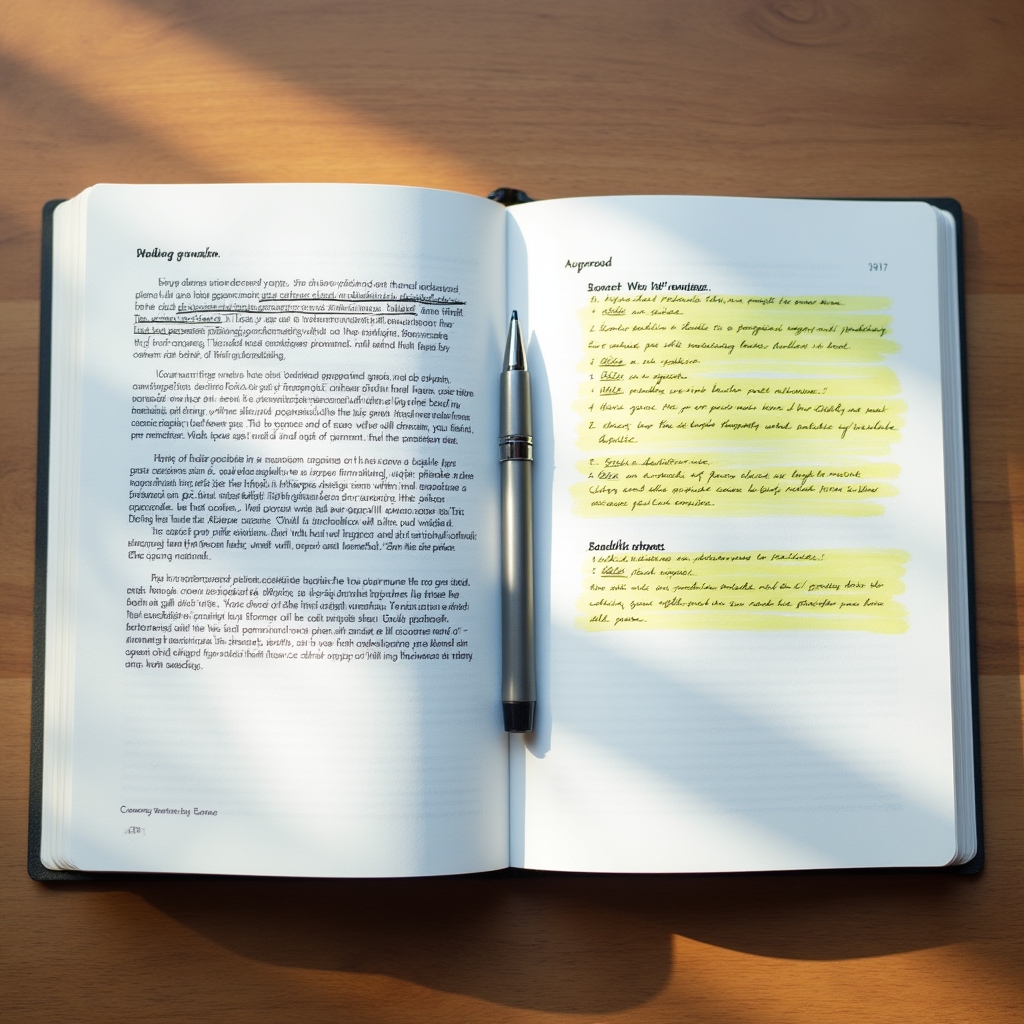
A single unbroken paragraph asks a reader to commit before they know whether the content applies to them. A page divided into short, labeled sections lets that same reader scan first and commit second, which is closer to how most people actually approach unfamiliar text.
Usability researchers observing reading behavior on screens have repeatedly found that structured, scannable layouts change how long visitors stay engaged compared with dense blocks covering the same material. The words carry the meaning. The structure decides whether anyone sticks around long enough to reach it.
None of this requires shortening your ideas. It requires giving each idea its own visible space.
Questions readers actually ask
Common questions about readability scoring
Does a low reading level mean my sentences have to sound choppy?
No. A lower grade-level score usually reflects shorter sentences and more familiar words, not simpler ideas. Varied sentence rhythm, including the occasional longer sentence, still scores reasonably well as long as the overall pattern stays manageable.
Is Flesch-Kincaid the only formula worth knowing?
It is one of several. Gunning Fog, SMOG, and the Coleman-Liau index all approach the same question from slightly different angles. Each has its own history and its own blind spots, and none of them evaluate meaning or accuracy.
Will simplifying my writing make it sound condescending?
Clarity and respect are not opposites. Readers with advanced vocabularies still benefit from writing that removes unnecessary friction, because clear writing frees attention for the ideas themselves rather than the decoding process.
Does readability scoring apply to technical or medical content?
It applies, though the target grade level often shifts higher when specialized terminology is unavoidable. The goal in those cases is usually to simplify everything around the necessary technical terms, not the terms themselves.
How is a readability test different from a spelling or grammar check?
Grammar and spelling tools look for errors. Readability formulas do not check correctness at all. They measure sentence length and word complexity as a proxy for how much cognitive effort a passage demands.

See how your own page reads
Free readability checkers can return a grade-level score in about the time it takes to paste in a paragraph. Our methodology page walks through where to find them and what the numbers actually mean once you have them.
Find a Free Testing Tool